Cultural Heritage Workshop
Extract from the last workshop:
​
On Saturday June 14, Parks Traditional Owner Country and Sea Country Partnerships Advisor Clinton Morton explained the background and heritage of the Prom in an extraordinary eye-opening day for Friends of the Prom. The 25 members present at Stockyard Camp were able to learn and gain insights into the Prom’s history and Cultural Heritage and the role of past and present Traditional Owners and their long-time history at the Prom. Clinton Morton is a Parks Victoria Ranger of nine years, who has been stationed at the Prom for three and a half years. Wilsons Prom is ground-breaking in so many ways, and one area perhaps less recognised is that Parks Victoria is working closely and collaboratively with the Traditional Owners to manage and care for Country. The three Traditional Owner groups at the Prom are the Boonwurrung, Bunurong, and Gunaikurnai.
​
Wilsons Prom is the only National Park in Victoria with this structure, which is even more remarkable considering these three groups are engaged in a Native Title claim that is in the Federal Courts right now. This claim created an adversarial backdrop to the talks. MCT (Managing Country Together) and the District Operations staff have set up a governance framework that includes a LSC (Leadership Steering Committee) and PWG (Project Working Group) with Traditional Owner representatives to ensure culturally sound decisions are made when it comes to land management strategies. It is integral to building long and lasting respectful Partnerships with the three Traditional Owner groups. “The Partnership is based on respect and consistency, which means don’t promise anything you can’t deliver,” Clinton said. Clinton himself is a proud Wiradjuri man from central NSW.
​
“Wiradjuri are the people of the 3 bila (rivers). The 3 main rivers are Galari (the Lachlan River), Wambuul (the Macquarie River) and Marrambidya (the Murrumbidgee River). Milawa (the Murray River) borders our Country to the south,” he explained. Clinton’s workshop covered his role, the life of the Traditional Owners, their lifestyle and work, and culminated in a visit to the banks of Shallow Inlet to show how nature and climate change impacts are damaging middens and other Aboriginal sites. Among artifacts he showed the group was a small didgeridoo, a drumlike structure which makes a sound similar to female emus so when you play it, it attracts the male emus, which makes them easier to trap. A bull roarer is another way to communicate with mob. Other items included cutting stones, which were used to scrape flesh from possum skins to make possum skin or kangaroo skin cloaks.
​
He told us about emus, which may, in Clinton’s words, not be so smart but in traditional lore they were more than just birds. They were Creator spirits. Each Mob has their own Creator being, for example for the Wiradjuri, Biamie is the Creator spirit who is represented by a giant emu that left signs as he travelled across the earth and then ascended into the sky, where he can be seen today watching over and giving guidance. When you look up at the Southern cross, the dark space within the cross is the Emu’s head and the dark part within the Milky way is the Emu’s body. The direction the emu is facing informs Mob as to whether it is time for hunting or gathering eggs or time to leave them alone. Emus also illustrate the different roles some animals play with Traditional Owners as food, a source of company, amusement, and as spiritual guides. Male emus have the job of looking after the eggs and raising the young, after the eggs are laid by the females who then trot off to the next partner.
​
For Bunurong – Boon Wurrung as part of the Kulin Nation, Bunjil (eagle) and Whan (crow) are creator beings that soared through the skies above, looking over the land and people. For Gunaikurnai the Creator spirits are Boran (pelican) and Tuk (musk duck), who came down from the mountains and canoed across to the Prom. Fire was one of the most important land management tools. It was managed by the people for different reasons, including to burn to encourage new grass growth or tubers and to create landscape templates, even sometimes to chase kangaroos off a cliff to trap them. Fire is integral to Aboriginal People for many things– food, warmth, safety and especially as a land management tool. It is also a Totem and has its own stories and dreamings. However, it is also something controlled by the Traditional Owners only, so you would not light a fire on someone else’s Country.
As Traditional Owners (Custodians) of their Country there was an obligation to manage all of Country not just the pretty bits. In good seasons you manage the harsher parts of the country, which guaranteed that in harder seasons you had left the prime spots to fall back to. Traditional management was focussed on abundance for all creatures and plants, as for something to exist in tangible terms, it must exist in the Dreaming so is respected and cared for through Cultural Obligations.
Parks agreements and collaborations with Traditional Owners have allowed progress on issues like the proposed Prom Sanctuary fence and Sealers Cove boardwalk reconstruction and upgrade of toilets and campgrounds at Sealers, Refuge and Little Waterloo Bays as part of the Southern Circuit Walk. Morton explained, “We all want toilets at Sealers Cove upgraded, but where and how? Sometimes it’s just a matter of moving one metre to save impacting Cultural Heritage and sometimes adjusting designs to minimise ground disturbance, which protects the Heritage…The key was to build relationships not projects,” he said. Work on the fence is due to start this year and is aimed at preventing destructive feral animals like foxes, cats and deer from entering the park. It will also improve conservation programs, including invasive species control, largescale habitat restoration and active threatened species recovery programs.
The Prom (Yiruk Wamoon) currently has 400 recorded Aboriginal sites but only a tiny proportion of Wilson Prom (Yiruk Wamoon) has been surveyed for Tangible Cultural Heritage, less than 1% of the 59,000 Ha that make up the Prom. Most of the large and most beautiful sites are now in private hands. The best sites were often the first sites to be taken up by European settlers, as these were the most productive areas with access to fresh water, and had been managed from the beginning of time to create abundance for all parts of the environment, not just what is best for humans. The traditional owners were at first not supporters of the proposed predator-proof fence. They understand the benefits of the fence, but because previously only a small part of the Prom has been surveyed for Cultural Heritage, it took seven to eight months of work to establish just where to put the fence. Also, historically fences did not exist before Colonization and once they did, they were used to either keep Mobs in or out. “These decisions are not decided by Parks Victoria alone. How the Traditional Owners ancestors are looked after, that needs to be guided 100 per cent by the Traditional Owners,” Clinton said. “Managing Country Together is how we do this. It is Parks Victoria commitment to strong, meaningful partnerships with Traditional Owners. It is about understanding and respecting Traditional Owner rights and values, taking responsibility for protecting Aboriginal Cultural Heritage on the parks estate and offering the best support we can to Aboriginal people working in the park management sector,” he added. The native title claim over Wilsons Promontory National Park is a complex matter involving multiple Traditional Owner groups. The Gunaikurnai people, who call the Prom, Yiruk (meaning rocky place), lodged a claim which ran from Wilsons Promontory to Cape Liptrap in 2014. It is currently part of a Federal Native Title case that has been lodged by Boon Wurrung that encompasses all of the Bunurong RAP area plus from Tarwin River to Wilsons Prom and up to Mirboo North. Wamoon is the Bunurong–Boonwurrung word for Wilsons Prom. The Gunaikurnai later decided to withdraw from the court case to focus on mediation with the other groups.
​
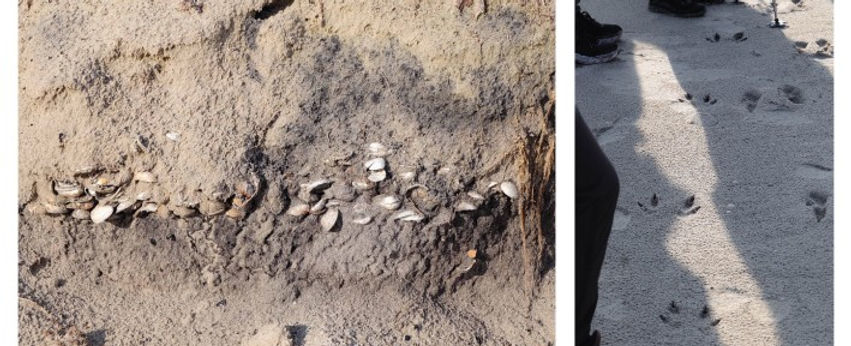
Clinton said that one of the challenges was, “Traditional Owners lack trust with Government. Consistency is the key to gaining and maintaining trust,” he emphasized. Traditional owners say, “Come walk with us, talk to us and let’s make these decisions together. Most of the best work is done yarning around a campfire,” Clinton said. The site FOTP visited with Clinton was a midden on Shallow Inlet and reached via Hourigan’s Camp Lane off Millar Road near Yanakie. “Midden actually means rubbish tip. That is how they were first described by archaeologists…but it doesn’t translate very well,” Clinton said. Shell middens are the remains of meals of shellfish once gathered and eaten by traditional owner groups and when they moved on, they provided a history, so that the next group that came to the spot could see what others had eaten, how long ago and could moderate their diet accordingly. The midden was evident by looking at the exposed embankment, but while the group was standing listening, one member identified a small stone used for cutting by the Traditional Owners. This finding underlined the richness of Traditional Owner Heritage in the Prom and explained why each step must be taken with the awareness of the long-time history of this land. This even includes work done with good intentions like weeding sea spurge. Clinton explained that the land up to Darby River in the Prom was open all members of the clan but beyond Darby River it was replete with ceremonial sites and few people were allowed to visit Tidal River. He explained saying, “(When I talk about) Culture and Heritage I am referring to the tangible items, the physical things that are still visible today, whether they be middens, which are generally full of shells (but sometimes contain burials), stone axes, stone tools, scar trees, or rock art.” “For Traditional Owners, it’s a very spiritual place and also a site of physical evidence showing past occupation. These things are so old,” he added. “We have one midden along the west coast of the Prom here that is 55 hectares. Roughly, if I am getting my numbers right, close to 200 acres - just of shells. So, you’ve got the same groups of people coming back to the same areas over thousands of years and thousands of people,” Clinton said. “Sometimes we find burials in there as well, in those midden sites that you would come back to again. You would be sitting there retelling the stories of an old Aunty or Uncle who is buried there and their life and the stories they passed on to you. And that continues that connection,” he said. Some first nations Lore is more easily translatable than others. For example, “Dooligah refers to a mythical, large, hairy creature or spirit often associated with Australian Aboriginal Cultures, particularly in Southeast Australia. It is similar to the Concept of a Yowie and is often described as a giant, hairy man-like creature. Some accounts also describe them as shy and even dangerous, especially at night! In other words, kids shut up and go to sleep,” Clinton added. “Seeing prohibited artifacts out of country can make you sick,” he said, adding “Melbourne museum is full of artifacts which should be returned to sites.”
When ancestral remains including a skull were found near Darby River, Clinton camped the night by it to protect it. Many sites can’t be assessed because people are not aware of where they are. Much of Clinton’s work is to protect sites or record them before they fall victim to Climate Change and the impacts of nature. This can happen quickly, as shown at Shallow Inlet. Here the mouth of the river is moving south at the rate of 50 metres a year. On the banks of Shallow Inlet Parks Victoria is working to save one midden site. Parks Restoration Ecologist Brooke Love is working with Morton to sandbag to protect the bank and strengthen it by replanting. The Big Drift is rich with Cultural Heritage sites and was exposed by the impact of falling sea levels leaving exposed calcareous sands, which once were covered by vegetation that was eaten away by introduced animals like the cattle which still occupy the park perimeter. Clinton explained, “If we think that a Cultural site is going to be disturbed and destroyed, what are we going to choose to do in that situation? If we choose to go in and try and protect what is there and we’re going to do a dig and gather back what we can so we can protect it somewhere else, that’s making a deliberate choice to go in and potentially disturb a burial site. They would’ve been buried with proper ceremony and protocol - and you’re breaking that,” he added. It’s a complexity most Prom visitors may not realise.
​


